Doctors treating Michael Schumacher
said on Monday they were fighting "hour by hour" to save the former
Formula One driver's life after he cracked his head on a rock during an
off-piste skiing accident in the French Alps.
Dr
Jean-Francois Payen, the chief anaesthesiologist at the Grenoble
hospital treating Schumacher, said the next 48 hours would be crucial. A
brain scan revealed internal bleeding and multiple lesions. "He is in a
critical condition … His condition is deemed very serious," Payen told a
news conference. "For the moment, we cannot predict the future for
Michael Schumacher."
The seven-times Formula One champion was
airlifted to Grenoble on Sunday after falling heavily and hitting his
head while skiing on an unmarked slope at the chic resort of Méribel.
It
soon emerged that the accident, initially played down by a spokesman
for the resort, had a devastating impact on Schumacher, who was in a
coma by the time he arrived at Grenoble.
"He is in a critical
state of cerebral resuscitation," said Payen. "We are working hour by
hour." Doctors said his ongoing treatment was aimed at oxygenating the
brain and stopping the swelling. On Monday night, Schumacher, due to
turn 45 on Friday, remained in a medically induced coma designed to help
his recovery.
The gravity of the retired champion's condition
prompted figures from across the sporting world to express their shock
at the accident and solidarity with a man regarded as one of the
greatest racing drivers in Formula One's history.
The current
world champion and fellow German Sebastian Vettel, who has been dubbed
"Baby Schumi" by his country's media, led a chorus of support and
concern from the sport. "I am shocked and hope that he gets better as
quickly as possible. I wish his family much strength."

The British driver Jenson Button, another former world champion,
said: "My thoughts are with Michael Schumacher at this tough time.
Michael more than anyone has the strength to pull through this."
Angela Merkel, the German chancellor, said she was "extremely shocked along with millions of Germans".
Schumacher's
wife, Corinna, and their two children, were with him in hospital on
Monday. So too was Gérard Saillant, a leading brain surgeon from Paris
who had rushed to Grenoble on Sunday to be with his former patient and
friend.
Asked about his chances of survival, Saillant told
journalists: "Someone of 70 is less likely to survive this sort of
accident than someone who is 45, and someone like Michael who is in top
condition is more likely to survive than someone else."
The
doctors were clear that, if Schumacher had not been wearing a helmet at
the time of his fall, he would not have survived. "Someone who had had
this kind of accident without a helmet would certainly not have made it
this far," said Payen.
According to one French media report, the
blow to Schumacher's head was so fierce that the helmet cracked. That
could not be independently confirmed, but prosecutor Patrice Quincy,
based in Albertville, the home of the 1992 Winter Olympics, said: "The
victim lost his balance and banged his head extremely violently on small
rocks concealed by the snow."
Two ski patrollers arrived at the
scene of the accident immediately, Quincy added, a rescue process which
soon saw the sportsman taken by helicopter to the nearest hospital at
Moûtiers.
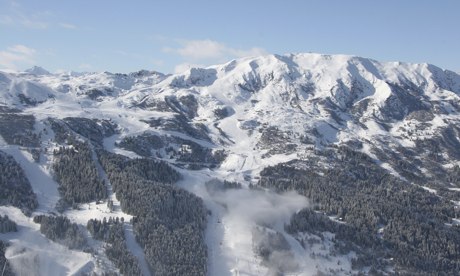
Schumacher is thought to have been skiing downhill
between two marked pistes below the jagged peaks of the Dent de Burgin
when he fell, hitting the right side of his head.

Investigators
from the gendarmerie based in the resort of Bourg St Maurice were on
Monday on the mountainside attempting to establish the exact
circumstances of the accident, which occurred at 2,100 metres.
After the impact, Schumacher was conscious but "stunned",
neurosurgeon Stephan Chabardes said. "He didn't respond to questions
after the accident. He didn't have a normal neurological reaction," he
told the news conference. By the time he was brought to the hospital at
Grenoble, which has an internationally-recognised trauma centre,
Schumacher was in a coma.
Tony Belli, a consultant neurosurgeon
and reader in neurotrauma at Birmingham University, said that
Schumacher's age, fitness and psychological strength would help his
recovery. "He's got a lot of factors in his favour," he said. "He's more
likely than not to make a good recovery, despite all the concerns that
have been raised.
"From the description of his injuries, it will take weeks, even months to recover, but I do expect him to make a good recovery."
Outside the hospital, fans mingled with television crews as the wait for a further update went on into the night.
Dressed
in a red Ferrari cap, jacket and T-shirt, Enzo Debar, 31, said he had
come to the hospital "to be close to him, to do what is possible, as a
fan. I hope he'll get better. I am sure he will get better, because he's
a fighter."
Sharing his hope was Patrick Amatucci, from Grenoble,
who had come down with his son. He described Schumacher, whom he had
followed from his days with Benetton, as "a great, good man", with
greatness in his blood.